

📊 Economy · June 19, 2026
Warsh's Hawkish Turn at the Fed: Why Interest Rates Are Signaling Higher and Where Global Capital Is Headed
In his first meeting as Federal Reserve Chair, Kevin Warsh presided over a policy decision that was technically a hold but delivered one of the more hawkish surprises in recent cycles. On June 17, 2026, the FOMC voted unanimously to keep the federal funds rate in the 3.50–3.75% range for the fourth consecutive meeting.
In his first meeting as Federal Reserve Chair, Kevin Warsh presided over a policy decision that was technically a hold but delivered one of the more hawkish surprises in recent cycles. On June 17, 2026, the FOMC voted unanimously to keep the federal funds rate in the 3.50–3.75% range for the fourth consecutive meeting. What mattered far more was what came with it: a sharply higher median dot-plot projection, the removal of any easing bias from the policy statement, and an explicit commitment to “deliver price stability” after missing the 2% target for more than five years.
The message to markets was clear: the path of least resistance for policy has shifted from cuts toward the possibility of hikes if inflation does not moderate.
The Numbers Behind the Hawkish Signal
The June Summary of Economic Projections (SEP) told the real story. The median projection for the appropriate federal funds rate at the end of 2026 was lifted to 3.8%, up from 3.4% in the March projections. Nine of 18 FOMC participants now see at least one 25-basis-point rate hike by year-end; several see two. The median for 2027 sits around 3.6%, with the longer-run neutral rate anchored near 3.1%.
Inflation projections were revised significantly higher. Core PCE inflation for 2026 is now expected to average 3.6%, a material upward shift that reflects both recent data and a more cautious assessment of underlying price pressures. May 2026 CPI came in at 4.2% year-over-year — the highest in more than three years — with the energy component heavily influenced by Middle East geopolitical tensions. Core CPI registered approximately 2.9%.
Economic activity remains resilient. The SEP shows 2026 GDP growth at 2.2%, with the labor market continuing to deliver solid job gains and unemployment near 4.3%. This combination — above-target inflation alongside a still-healthy real economy — is precisely the environment in which a data-dependent, inflation-focused chair can justify a higher-for-longer (or even higher) rate path.
Warsh reinforced the shift in tone during the press conference. He repeatedly emphasized that “this Committee will deliver price stability” and stated plainly that the Fed had “missed for five years” on its inflation objective. The policy statement itself was shortened dramatically, forward guidance was stripped out, and Warsh signaled that the Committee would review its communications toolkit, including the role of the dot plot itself. This is not the language of a central bank preparing to ease.
Why Did Rates “Signal a Rise”?
The signal did not come from the current policy rate — it came from the expected path. Markets had been positioned for a gradual cutting cycle. The new dot plot effectively removed that base case for 2026 and replaced it with a distribution in which hikes are now a live possibility for a material number of participants.
Three factors drove the repricing:
-
Inflation persistence is no longer viewed as transitory. The combination of geopolitical energy shocks and a resilient domestic economy has kept headline and core measures elevated. The Fed’s own projections now embed that reality.
-
The removal of the easing bias. Previous statements had contained language that markets interpreted as a dovish tilt. Its absence, in Warsh’s more terse statement, was read as deliberate.
-
Warsh’s personal stamp. As a former governor with a reputation for skepticism toward prolonged accommodation, Warsh used his debut to establish credibility on price stability. The market reaction — 2-year Treasury yields jumping roughly 16 basis points intraday and the S&P 500 declining more than 1% — showed that investors understood the shift.
Where Global Money Flows Are Headed
A hawkish Fed with a higher projected rate path and a stronger dollar has immediate consequences for global capital allocation.
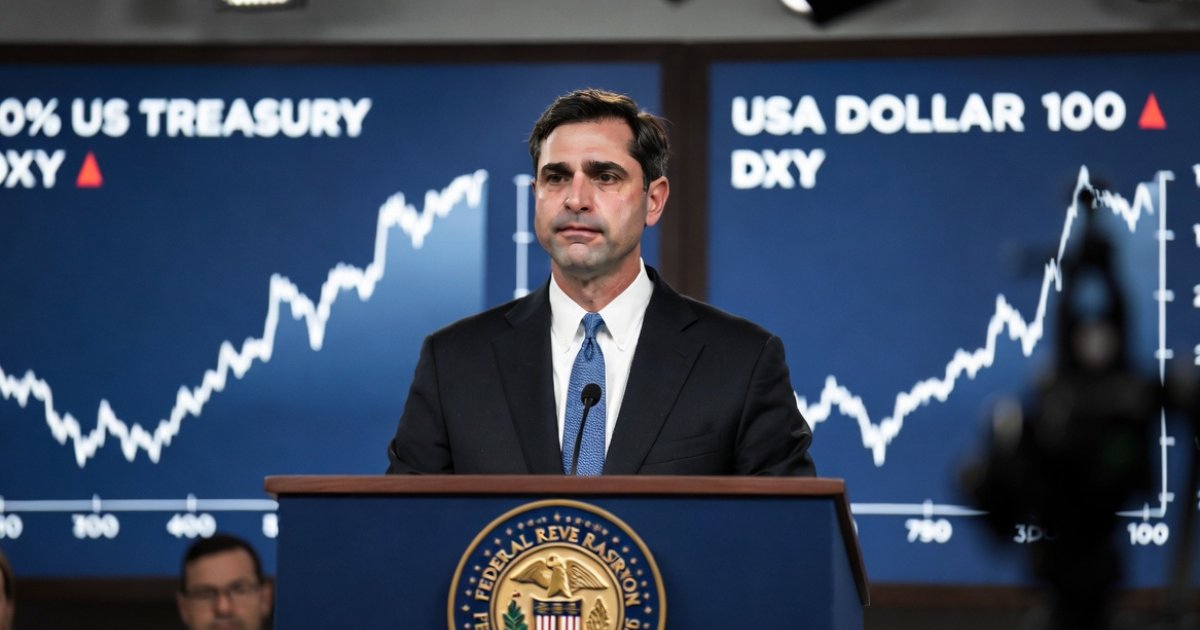
The US Dollar Index (DXY) rallied sharply after the decision, breaking above the psychologically important 100 level for the first time in months and reaching session highs near 100.40. This move reflects both higher US rate expectations and the classic “flight to quality and yield” dynamic.
US Treasuries benefit directly. Higher projected policy rates and sticky inflation support nominal yields. The 10-year Treasury yield moved toward the 4.49–4.55% area in the immediate aftermath, while shorter-dated yields led the move higher. Foreign investors, particularly those seeking liquid, high-quality dollar assets, have a renewed incentive to allocate to US fixed income.
Emerging markets face the opposite pressure. History and empirical evidence show that US monetary tightening episodes — especially when accompanied by dollar strength — trigger portfolio outflows from EM equities and bonds. Non-bank financial institutions (the dominant source of cross-border portfolio flows to EMs in recent years) are particularly sensitive to shifts in global risk appetite and US rate differentials. A stronger dollar also increases the local-currency burden of any USD-denominated debt, tightening financial conditions even before local central banks react.
Commodity markets and gold initially sold off on the combination of a stronger dollar and some de-escalation in Middle East tensions, illustrating how the monetary signal can override geopolitical factors in the short term.
Carry trades funded in dollars or tied to expectations of Fed easing are being reassessed. The repricing is already visible in FX markets, with the euro and other major currencies weakening against the dollar.
Analytical Implications
The current configuration is one in which the Fed is prioritizing the restoration of its inflation credibility over near-term growth support. Warsh’s explicit rejection of the notion that the central bank faces a “cruel choice” between inflation and employment suggests he views the Phillips curve relationship as less binding in the current environment — or at least that the costs of tolerating above-target inflation for longer are higher than previously assumed.
For global investors, the implication is a continued preference for US assets, particularly high-quality fixed income, at the expense of EM risk assets and non-dollar exposures. This does not mean a sudden stop in EM flows, but it does suggest a period of tighter external financial conditions for more vulnerable economies — those with large current-account deficits, high foreign-currency debt, or weaker policy credibility.
US equities, particularly rate-sensitive growth names, face valuation pressure from higher discount rates, though the underlying earnings backdrop remains supported by a resilient economy. The rotation toward value, financials, and energy (to the extent geopolitics allows) is a logical portfolio response.
Outlook
The June SEP and Warsh’s communications have shifted the Overton window. Markets are now pricing a higher probability of at least one hike in 2026 and a later, shallower cutting cycle than previously expected. Whether that path materializes depends on incoming data — particularly the evolution of core services inflation and the labor market.
What is already clear is that the Fed under Warsh has chosen to lead with its inflation-fighting credentials. Global capital is responding in the classic manner: flowing toward the jurisdiction offering higher expected returns in a strong currency. For now, that jurisdiction is the United States.
References
Federal Reserve. (2026, June 17). FOMC statement. Board of Governors of the Federal Reserve System. https://www.federalreserve.gov/monetarypolicy/fomccalendars.htm
Federal Reserve. (2026, June 17). Summary of Economic Projections. Board of Governors of the Federal Reserve System. https://www.federalreserve.gov/monetarypolicy/files/fomcprojtabl20260617.pdf
U.S. Bureau of Labor Statistics. (2026, June 10). Consumer Price Index – May 2026. https://www.bls.gov/news.release/cpi.nr0.htm
Board of Governors of the Federal Reserve System. (2026, June 18). Selected interest rates (H.15). https://www.federalreserve.gov/releases/h15/
CNBC. (2026, June 18). Markets are set for a much more hawkish Warsh Fed than expected. https://www.cnbc.com/2026/06/18/markets-are-set-for-a-much-more-hawkish-warsh-fed-than-expected.html
Fortune. (2026, June 17). Kevin Warsh showed that he's decisively not Trump's 'sock puppet' at the Fed. https://fortune.com/2026/06/17/how-did-market-react-kevin-warsh-press-conference-inflation-rates/
Reuters. (2026, June 17). Fed holds steady in Warsh's debut, but hawkish shift fuels bond-market rout. https://www.reuters.com/business/view-fed-holds-steady-warshs-debut-analysts-see-hawkish-shift-2026-06-17/
New York Times. (2026, June 17). Fed Holds Rates and Leans Toward Fighting Inflation With Higher Rates. https://www.nytimes.com/live/2026/06/17/business/fed-meeting-warsh-interest-rates
International Monetary Fund. (2026, April). Global Financial Stability Report, Chapter 2: Capital Flows to Emerging Markets. https://www.imf.org/en/Publications/GFSR