📘 Explainer · June 11, 2026
Artificial Intelligence Reshapes Global Manufacturing: From Predictive Maintenance to Digital Twins — Economic Imperatives, R&D Acceleration, and Industry Leaders
In an era defined by supply-chain fragility, labor shortages, decarbonization mandates, and intensifying global competition, artificial intelligence has transitioned from experimental pilots to a core strategic lever in manufacturing.
In an era defined by supply-chain fragility, labor shortages, decarbonization mandates, and intensifying global competition, artificial intelligence has transitioned from experimental pilots to a core strategic lever in manufacturing. What began as targeted applications in predictive maintenance and quality inspection is evolving into comprehensive digital twins, generative design tools, industrial copilots, and emerging agentic and physical AI systems. These technologies are not merely incremental efficiency plays; they are fundamentally altering cost structures, innovation velocity, capital allocation decisions, and the economics of research and development within the sector.
According to MarketsandMarkets, the global AI in manufacturing market is projected to expand from approximately USD 34.18 billion in 2025 to USD 155.04 billion by 2030, reflecting a compound annual growth rate (CAGR) of 35.3%. Other reputable estimates place the 2024–2025 base between roughly USD 4–13 billion with CAGRs ranging from 31% to over 42% through the early 2030s, underscoring robust — if variably measured — momentum. Generative AI is frequently cited as the fastest-growing technology segment, while predictive maintenance and machinery inspection remain the largest application areas by revenue share. North America holds the largest regional share (around 43% in recent data), with Asia-Pacific exhibiting the highest growth rates.
Latest Developments: From Reactive Operations to Intelligent, Adaptive Systems
The most mature and widely deployed AI application in manufacturing remains predictive maintenance. Machine learning models analyzing vibration, temperature, acoustic, and operational sensor data can forecast equipment failures 48–72 hours (or more) in advance. Real-world deployments have delivered substantial results: Johnson & Johnson India reduced unplanned downtime by 50% using ML-based predictive maintenance; Unilever Brazil cut maintenance costs by 45% at a major powder detergent facility; and various automotive and heavy machinery cases report 20–30% reductions in unplanned downtime alongside millions in annual savings (e.g., Shell’s deployment across 10,000+ assets generating 15 million daily predictions).
Quality control and inspection have been transformed by computer vision and anomaly detection. Bosch Türkiye, for example, improved overall equipment effectiveness (OEE) by 30 percentage points through AI-driven anomaly detection. These systems move beyond simple pass/fail to root-cause analysis and prescriptive actions, reducing scrap rates dramatically — in one Siemens NX CAM/digital tools deployment, scrap fell below 1%.
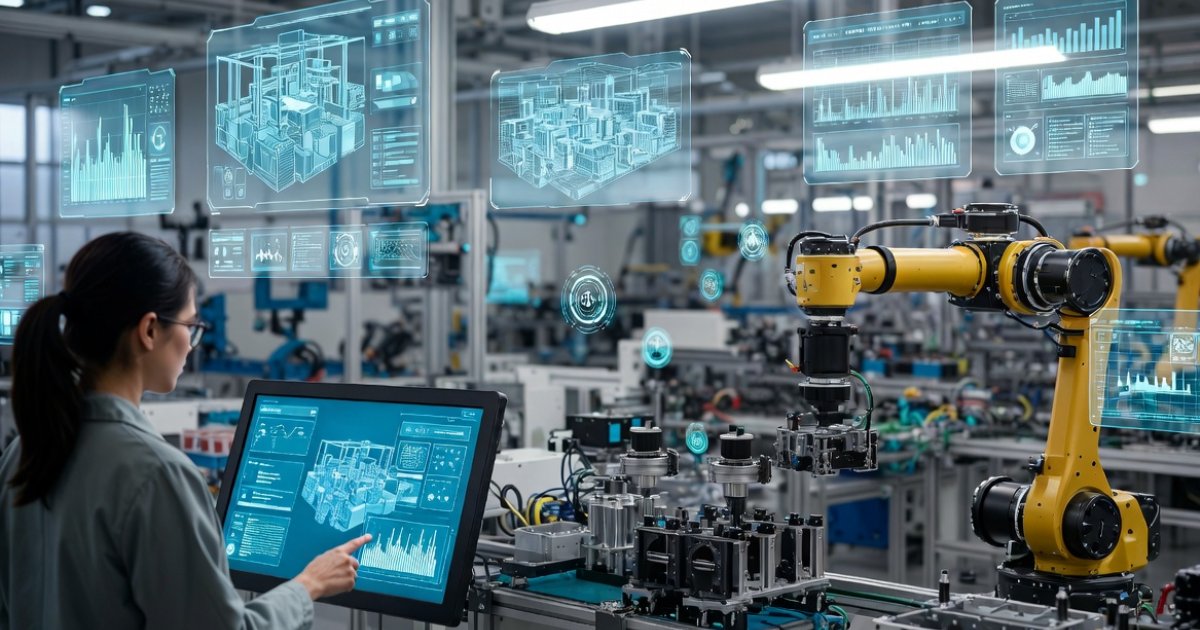
Digital twins — virtual replicas of physical assets, processes, or entire factories continuously fed by real-time sensor data — represent a step-change. Combined with AI and high-fidelity simulation platforms, they enable virtual commissioning, process optimization, capacity planning, and “what-if” scenario testing without disrupting live production. NVIDIA’s Omniverse platform, integrated with Siemens’ Xcelerator and Digital Twin Composer, has demonstrated simulation speedups of up to 1,200x in complex computer-aided engineering (CAE) workloads. Siemens’ own Beijing factory, designed and validated via digital twin methodologies, achieved approximately 20% higher productivity than legacy facilities. Customers such as PepsiCo, Schaeffler, and Rockwell Automation partners are using these tools to test layouts, optimize energy flows, and validate automation before physical implementation.
Generative AI and industrial copilots are extending accessibility. Siemens’ Industrial Copilot (built with Microsoft Azure) allows engineers and operators to query machine status, receive maintenance guidance, or generate design/prototyping assistance via natural language. One documented case showed configuration time reduced by 95%, with engineers freed for higher-value work. Generative models are also accelerating product design (generative design exploring thousands of iterations under constraints), CNC program generation, and synthetic data creation for training vision or robotics systems.
Emerging frontiers include agentic AI (autonomous agents that plan and execute multi-step tasks) and physical AI (humanoid and collaborative robots with greater autonomy). Manufacturing Leadership Council surveys from early 2025 indicated nearly one in four manufacturers planning physical AI deployments within two years (more than double current rates). NVIDIA–Siemens partnerships aim at fully AI-driven adaptive factories, with the Siemens Electronics Factory in Erlangen, Germany, positioned as an early blueprint. Humanoid robot field tests (e.g., Boston Dynamics Atlas at Hyundai facilities) signal the convergence of simulation, AI, and embodied robotics.
Economic Dimensioning: ROI Realities, Productivity Gains, and R&D Transformation
Headline market growth is impressive, but the economic substance lies in realized returns, capital efficiency, and the acceleration of innovation itself.
Survey evidence presents a nuanced picture. McKinsey’s 2025 State of AI Global Survey found that while 88% of organizations use AI in at least one function and many report cost or revenue benefits at the use-case level (particularly strong in manufacturing, software engineering, and IT operations), only 39% attribute any enterprise-level EBIT impact to AI — and for most of those, the contribution remains below 5% of total EBIT. High performers (roughly 5–6% of organizations) distinguish themselves by redesigning workflows end-to-end, combining efficiency objectives with growth/innovation goals, and scaling beyond isolated pilots.
Deloitte surveys similarly indicate that satisfactory ROI on typical AI use cases is often achieved within 2–4 years, with some projects delivering payback in under a year and others taking longer, especially for more complex agentic or enterprise-wide deployments. Manufacturing-specific analyses suggest strong potential: predictive maintenance and quality use cases frequently deliver 200%+ ROI when scaled, with compounding effects across production volume. A single line achieving 2% yield improvement on high-volume output can generate hundreds of thousands in annual savings; multiplied across plants, the impact becomes transformative. BCG and other analyses note that manufacturers scaling AI across five or more use cases achieve significantly higher cumulative ROI than single-use-case deployers.
R&D processes are undergoing particularly profound economic re-dimensioning. Traditional manufacturing R&D — physical prototyping, iterative testing, and lengthy design cycles — is capital- and time-intensive. AI-driven simulation, generative design, and digital twins compress these cycles dramatically. Engineers can explore vastly larger design spaces, validate performance virtually, and reduce reliance on expensive physical builds and trials. NVIDIA Omniverse-enabled workflows have shown order-of-magnitude speedups in simulation; Siemens deployments demonstrate accelerated design-to-production timelines and lower scrap during ramp-up. Studies in adjacent sectors (e.g., pharmaceutical manufacturing) quantify AI adoption lifting new product output per unit of R&D spend, with mechanisms including better allocation of skilled researchers and data-driven prioritization. In manufacturing, this translates to faster time-to-market for new products or process improvements, lower innovation risk capital, and improved returns on R&D budgets — critical in an environment where manufacturers face pressure to customize at scale while maintaining cost discipline.
Broader productivity effects are material. AI tools are estimated to deliver average labor cost savings in the 25% range on applicable tasks (with projections rising over time), alongside gains in energy efficiency, waste reduction, and supply-chain resilience. Accenture has previously projected manufacturing as one of the largest beneficiaries of AI-driven value creation globally (multi-trillion-dollar potential by 2035 in some long-term models). These gains help offset labor shortages through augmentation (skilled workers supervising and interpreting AI outputs) rather than pure displacement, while supporting sustainability goals via optimized energy loads and circular design.
Challenges to value capture remain significant: legacy data quality and integration issues, skills gaps, high upfront infrastructure costs (sometimes underestimated in business cases), cybersecurity risks in connected environments, and the difficulty of scaling from pilot to enterprise-wide impact. Organizations that treat AI as a strategic transformation program — with clear governance, workflow redesign, and phased investment anchored in measurable KPIs — outperform those pursuing fragmented experiments.
Key Players: Ecosystem Builders and Vertical Specialists
The competitive landscape features a mix of industrial automation incumbents, technology enablers, and software/platform specialists.
Siemens stands out for its end-to-end industrial AI and digital twin portfolio (Xcelerator platform, Digital Twin Composer, Industrial Copilot). Deep partnerships with NVIDIA (Omniverse integration) and Microsoft position it as a central orchestrator of the industrial metaverse and AI-driven factories. Demonstrated outcomes in its own operations and customer deployments (productivity lifts, commissioning time reductions) reinforce credibility.
NVIDIA functions as the foundational compute and simulation layer. Its GPUs power AI training and inference; Omniverse delivers physics-accurate, photorealistic digital twins and robotics simulation at unprecedented speed. Strategic collaborations with Siemens, Rockwell, automotive OEMs, and semiconductor manufacturers (e.g., SK Hynix fab optimization) extend its influence across the value chain without traditional manufacturing ownership.
Rockwell Automation excels in discrete and hybrid manufacturing with its FactoryTalk suite. Integration of Azure OpenAI enables natural-language-to-automation-code capabilities, accelerating engineering workflows. Strong focus on predictive maintenance, quality, and production optimization delivers tangible operational ROI.
GE Vernova (via GE Digital) leverages deep domain expertise in asset-intensive industries with AI-powered asset performance management and predictive analytics, helping customers reduce risk and optimize high-value equipment fleets.
Other notable players include ABB (robotics + AI automation), Fanuc (industrial robotics), Schneider Electric and Honeywell (process automation and energy optimization), and enterprise software giants SAP, Oracle, and PTC/Dassault Systèmes embedding AI into PLM, ERP, and supply-chain platforms. Cloud hyperscalers (Microsoft Azure, AWS, Google Cloud) provide the scalable infrastructure and generative AI services that many of these solutions rely upon.
The ecosystem is increasingly collaborative: hardware (NVIDIA), simulation/digital twin platforms (NVIDIA + Siemens), automation/control layers (Rockwell, ABB, Siemens), and domain-specific analytics form integrated stacks. Winners are likely to be those offering open, interoperable platforms that lower integration friction for manufacturers while delivering measurable outcomes at scale.
Outlook and Strategic Implications
AI in manufacturing is moving beyond isolated wins toward systemic transformation. Agentic and physical AI, deeper digital-physical convergence via advanced twins, and tighter integration with supply-chain and sustainability objectives will define the next phase. Policy support — tax incentives for smart manufacturing investment, R&D credits, and infrastructure for secure data/AI ecosystems — will influence regional competitiveness.
For financial decision-makers and strategists, the imperative is clear: treat AI not as a technology spend but as a capital allocation and operating model decision. Prioritize use cases with clear, measurable ROI (predictive maintenance and quality often deliver fastest), invest in data foundations and workforce capabilities, redesign workflows to capture full value, and partner within robust ecosystems. The 20% of organizations capturing the majority of AI-driven financial gains demonstrate that disciplined execution compounds advantages rapidly.
Manufacturers that successfully embed AI across operations and R&D processes will enjoy structurally lower costs, faster innovation, greater resilience, and enhanced sustainability performance. Those that lag risk competitive erosion in an industry where margins and market positions are increasingly determined by digital and analytical sophistication. The data and deployments of 2025–2026 indicate the window for strategic positioning remains open — but is narrowing.
References
MarketsandMarkets. (2025). Artificial intelligence in manufacturing market by offering, technology, application, industry, and region — Global forecast to 2030. https://www.marketsandmarkets.com/Market-Reports/artificial-intelligence-manufacturing-market-72679105.html
McKinsey & Company. (2025). The state of AI: Global survey 2025. https://www.mckinsey.com/capabilities/quantumblack/our-insights/the-state-of-ai
Deloitte. (2025). AI ROI: The paradox of rising investment and elusive returns. https://www.deloitte.com/nl/en/issues/generative-ai/ai-roi-the-paradox-of-rising-investment-and-elusive-returns.html
Deloitte Insights. (2025). 2026 manufacturing industry outlook. https://www.deloitte.com/us/en/insights/industry/manufacturing-industrial-products/manufacturing-industry-outlook.html
The Business Research Company. (2026). AI in manufacturing global market report 2026. https://www.thebusinessresearchcompany.com/report/ai-in-manufacturing-global-market-report
Tredence. (2024). Generative AI in manufacturing: Use cases, benefits & ROI. https://www.tredence.com/blog/generative-ai-in-manufacturing
ABI Research. (2026). Top 5 manufacturing trends to know in 2026. https://www.abiresearch.com/blog/top-manufacturing-trends
NVIDIA. (Various dates). Industrial facility digital twins and Omniverse use cases. https://www.nvidia.com/en-us/use-cases/industrial-facility-digital-twins/
Siemens. (2025–2026). Industrial Copilot and digital twin announcements and case studies. https://press.siemens.com/ and related Siemens Xcelerator resources.
Additional supporting data drawn from Rockwell Automation State of Smart Manufacturing Report, Manufacturing Leadership Council surveys, and industry case deployments referenced in the above analyses (2025–2026).