🏢 Company · June 14, 2026
Powering AI’s Growth: Meta Turns to Orbital Solar and Multi-Day Storage Solutions
Meta Platforms has responded with two early-stage technology partnerships designed to deliver reliable, around-the-clock clean power to its data centers: a capacity reservation for up to 1 GW of space-based solar energy from Overview Energy and up to 1 GW/100 GWh of ultra-long-duration storage from Noon Energy.
As artificial intelligence workloads expand, the electricity required to train and run large models is emerging as one of the most significant constraints on the sector’s growth. Meta Platforms has responded with two early-stage technology partnerships designed to deliver reliable, around-the-clock clean power to its data centers: a capacity reservation for up to 1 GW of space-based solar energy from Overview Energy and up to 1 GW/100 GWh of ultra-long-duration storage from Noon Energy.
The moves build on Meta’s existing clean energy portfolio, which already exceeds 30 GW of contracted renewable and low-carbon capacity, including substantial nuclear and geothermal commitments. They also reflect a broader pattern among hyperscalers confronting power availability, cost, and reliability challenges at unprecedented scale.
AI-Driven Demand Is Reshaping Electricity Markets
According to the International Energy Agency’s 2025 analysis, global data center electricity consumption reached approximately 415 TWh in 2024, representing about 1.5% of worldwide electricity use. In its base-case scenario, the IEA projects this figure will more than double to around 945 TWh by 2030 — slightly more than Japan’s current total electricity consumption — with data centers accounting for roughly one-tenth of global electricity demand growth over the period.
The acceleration is heavily concentrated in AI workloads. Accelerated servers, primarily driven by AI, are expected to grow at roughly 30% annually and account for nearly half the net increase in data center consumption through 2030. Conventional server demand grows far more slowly. In the United States, data centers already represent a material share of electricity demand growth, and regional markets such as PJM have seen capacity prices rise sharply as new loads come online.
Meta itself reported data center electricity consumption of roughly 18 TWh in 2024, up significantly from prior years, underscoring the company’s direct exposure to these trends. While the company matches 100% of its data center electricity with clean and renewable energy through power purchase agreements and other instruments, matching is not the same as physical, 24/7 carbon-free supply. Intermittency remains a core operational and reputational challenge.
Two Distinct Technical Approaches
Meta’s April 2026 announcement pairs two complementary solutions.
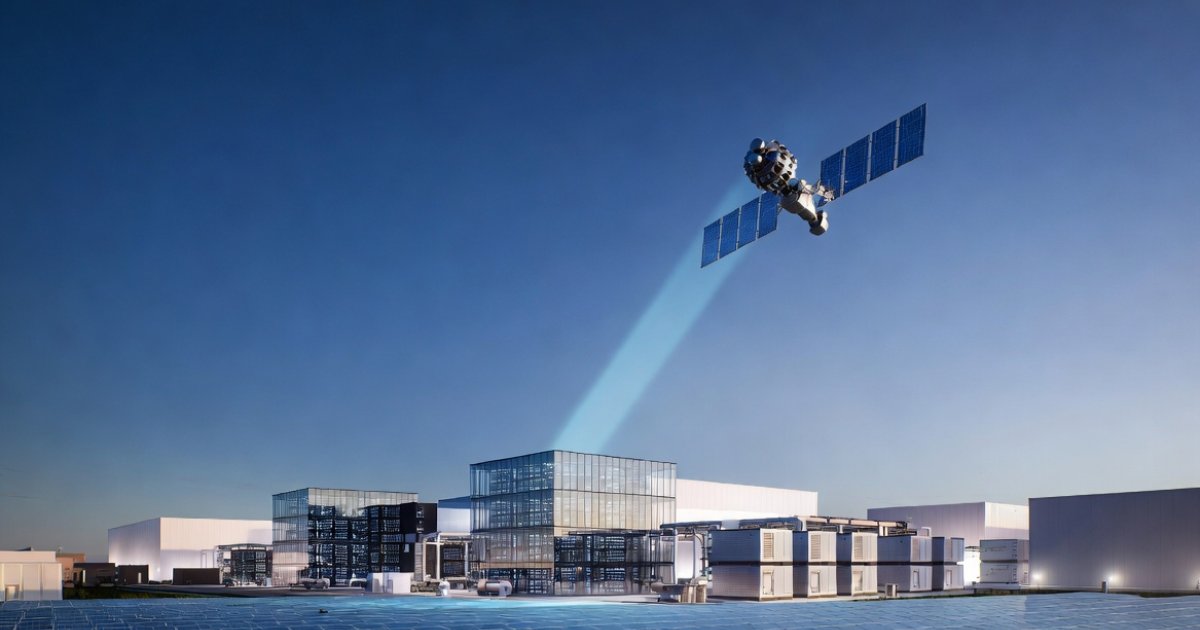
Space-based solar via Overview Energy targets the fundamental limitation of terrestrial solar: it only generates when the sun shines. Overview’s satellites would operate in geosynchronous orbit approximately 35,786 km above the equator, where sunlight is effectively continuous. Energy collected in orbit would be converted and beamed to existing ground-based solar farms as low-intensity near-infrared light. Those facilities would then convert the beam into grid-compatible electricity using the same infrastructure already in place for direct sunlight.
This approach is notable because it augments existing solar assets rather than requiring entirely new ground infrastructure or dedicated rectenna sites typical of some traditional space solar power concepts. If successful, it could increase the effective capacity factor of contracted solar farms without additional land use or major grid upgrades. Meta has reserved up to 1 GW of this capacity. An orbital demonstration is targeted for 2028, with potential commercial deliveries to the U.S. grid as early as 2030.
Ultra-long-duration storage via Noon Energy addresses the multi-day gaps that short-duration lithium-ion batteries cannot economically cover. Noon’s technology uses modular reversible solid oxide fuel cells paired with carbon-based storage media. Energy is stored chemically by converting inputs into a solid carbon medium; during discharge, the process reverses to generate electricity. The system is designed for 100+ hours of duration — far beyond typical battery storage — and uses abundant elements rather than scarce critical minerals.
Meta has reserved up to 1 GW / 100 GWh, with an initial 25 MW / 2.5 GWh pilot demonstration expected in 2028, followed by scaling. The modular design allows capacity to grow in line with data center expansion. This type of storage can firm intermittent renewables over extended periods, enabling higher penetration of variable generation while maintaining the high reliability required for AI infrastructure.
Economic and Strategic Context
Both technologies remain pre-commercial at the scale Meta has reserved, and timelines carry execution risk. Traditional space solar power concepts have historically faced high launch costs and conversion losses; Overview’s ground-augmentation model aims to mitigate some of these hurdles by leveraging existing solar farms. Independent technoeconomic studies (including recent Caltech analyses) suggest that mature space solar systems could eventually reach levelized costs competitive with other clean firm resources under favorable learning curves and launch cost reductions, though current concepts remain more expensive than terrestrial alternatives in most scenarios.
Long-duration storage faces its own challenges around round-trip efficiency, capital intensity, and the need for policy or market mechanisms that properly value multi-day reliability. Nevertheless, the direction of travel is clear: hyperscalers are no longer relying solely on short-duration batteries and standard renewables PPAs. They are actively de-risking and accelerating next-generation firm clean power technologies.
Meta’s broader portfolio already includes support for approximately 7.7 GW of nuclear capacity through agreements with Vistra, Constellation Energy, TerraPower, and Oklo, plus geothermal projects. The new partnerships extend this diversification strategy into even earlier-stage solutions.
Implications for Energy Markets and Investors
For electricity markets, sustained hyperscaler demand is likely to support higher utilization and pricing for firm, dispatchable, or fast-ramping resources. Regions with available transmission, favorable siting, and policy support for nuclear, geothermal, or advanced storage stand to benefit. Conversely, areas facing transmission constraints or slow permitting may see continued price pressure and reliability challenges.
For investors tracking the AI-energy nexus, the Meta announcement highlights several themes worth monitoring:
- Acceleration of corporate procurement beyond traditional renewables into firm clean power and long-duration storage.
- Potential for existing solar and wind assets to gain effective capacity through augmentation technologies.
- Growing importance of grid infrastructure and flexible resources capable of multi-day balancing.
- Execution risk around 2028 demonstration milestones that will determine whether these concepts move from pilot to meaningful scale in the early 2030s.
While individual technology bets carry high uncertainty, the aggregate direction — hyperscalers committing capital and offtake to de-risk novel clean firm power — appears structurally supportive for the broader energy transition.
Meta’s approach illustrates a pragmatic recognition that AI’s growth trajectory depends not only on chips and models but on the physical availability of reliable, low-carbon electricity at massive scale. The partnerships with Overview Energy and Noon Energy represent calculated bets on technologies that could, if successful, meaningfully expand the solution set available to the industry.
References
International Energy Agency. (2025). Energy and AI. IEA. https://www.iea.org/reports/energy-and-ai
Meta Platforms, Inc. (2026, April 27). Powering AI, strengthening the grid: Innovation in space solar energy and long-duration storage. https://about.fb.com/news/2026/04/powering-ai-strengthening-the-grid-space-solar-energy-and-long-duration-storage/
Noon Energy. (2026, April 21). Noon Energy and Meta announce plans for up to 1 GW of 100+ hour energy storage for data centers. https://www.noon.energy/post/noonenergyandmetapartnership
Overview Energy. (2026, April 27). Overview and Meta announce first-of-its-kind agreement to bring space solar energy to data centers. https://overviewenergy.com/updates/overview-and-meta
Goldman Sachs Research. (2025). Accelerating power demand from data centers is poised to boost new energy technologies. Goldman Sachs.
Mizrahi, O. S., et al. (2025). Space solar power generation: A viable system proposal. Joule. https://doi.org/10.1016/j.joule.2025.XXXX (Caltech SSP analysis)
Rodgers, E., et al. (2024). Space-based solar power. NASA Office of Technology, Policy, and Strategy.
Meta Platforms, Inc. (2025). 2025 Environmental data index. https://sustainability.atmeta.com