📊 Economy · June 14, 2026
Skilled Trades Crisis and Big Tech Solution: Meta Workforce Academy’s Macro Effects
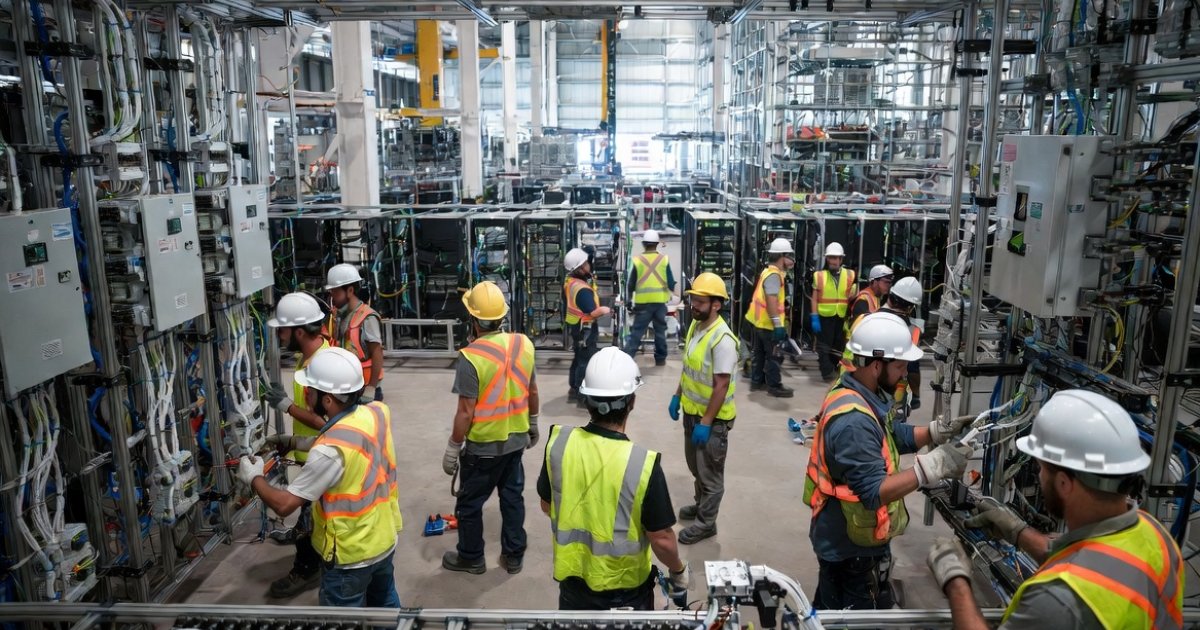
The artificial intelligence boom is not purely digital. It rests on a physical foundation of hyperscale data centers, power generation, fiber networks, and supporting infrastructure that demands hundreds of thousands of skilled tradespeople—electricians, welders, plumbers, pipefitters, HVAC technicians, and fiber specialists.
The artificial intelligence boom is not purely digital. It rests on a physical foundation of hyperscale data centers, power generation, fiber networks, and supporting infrastructure that demands hundreds of thousands of skilled tradespeople—electricians, welders, plumbers, pipefitters, HVAC technicians, and fiber specialists. The United States faces a structural shortage of these workers that threatens to constrain AI deployment timelines, inflate capex costs for technology leaders, and impose broader drags on GDP, housing supply, and productivity.
Meta Platforms’ launch of America’s Workforce Academy (AWA) in June 2026 represents the largest private-sector commitment to skilled trades training with an explicit job guarantee in U.S. history. With an initial $115 million first-year investment, the program delivers no-cost, fast-track training (approximately five weeks of hands-on instruction plus career readiness), covers travel and living expenses with a daily stipend, awards portable National Center for Construction Education and Research (NCCER) credentials plus an America’s Workforce Certificate, and guarantees job placement with contractor partners on Meta data center projects. Pilots are underway in Louisiana, Ohio, Indiana, and Texas, with recruitment open nationwide to veterans, career changers, recent graduates, and others with no prior experience required.
This is not corporate philanthropy in isolation. It is a calculated response to a binding constraint on one of the highest-ROI investment cycles in modern economic history.
The Scale of the Shortage: Numbers That Matter
Reliable estimates converge on a multi-million-worker gap with acute concentration in construction and mechanical-electrical-plumbing (MEP) disciplines critical to data centers.
- By 2030, projections indicate nearly 1.4 million unfilled positions across seven core trades, carrying an estimated $325.6 billion annual GDP loss, roughly 2.76 million total jobs foregone economy-wide, and $71.3 billion in lost tax revenue (Bring Back the Trades analysis).
- JLL research points to as many as 2.1 million unfilled skilled trades roles by 2030, with potential annual economic losses approaching $1 trillion when secondary effects are included.
- Construction alone requires a net addition of approximately 349,000 workers in 2026, rising to 456,000 in 2027 (Associated Builders and Contractors). Broader analyses cite ongoing shortfalls of 400,000–650,000 in the sector.
- Bureau of Labor Statistics (BLS) occupational projections (2024–2034) show strong structural demand: electricians +9% growth (~81,000 openings annually), HVAC technicians +8% (~40,100 openings annually), and plumbers/pipefitters +4%. These outpace the all-occupation average.
The aging workforce compounds the problem. Retirements significantly outpace new entrants (historically cited 5:2 replacement ratios in key sectors), with more than one in five construction workers already over age 55. Apprenticeship pipelines supply only a fraction of needed inflows—roughly 150,000 new workers annually against ~600,000 major skilled trades job postings.
Data center construction intensifies the pressure. Nearly 3,000 U.S. data center projects are planned or underway. Peak staffing on large facilities can reach 1,500–4,000 workers per site, with heavy concentration in high-skill MEP roles. Data center trades positions often carry wage premiums of up to 30% over general construction. Hyperscalers (Meta, Microsoft, Google, Amazon, etc.) are deploying hundreds of billions in capex; delays or cost overruns directly impair returns on AI infrastructure investments and, by extension, U.S. competitiveness versus state-backed rivals.
Housing and broader infrastructure feel parallel effects. A National Association of Home Builders/Home Builders Institute analysis attributed $10.8 billion in annual economic impact to skilled labor shortages in residential construction in recent data—driven by extended build times, higher carrying costs ($2.66 billion), and lost production of roughly 19,000 single-family homes.
Macroeconomic Transmission Channels
Capex Efficiency and AI Deployment Speed. Every month of delay on a data center translates into deferred AI model training capacity, lost cloud revenue, and slower productivity gains across the economy. Skilled trades shortages raise direct labor costs, extend schedules, and increase reliance on overtime or less-experienced crews (raising safety and quality risks). Meta’s program, by front-loading credentialed workers with guaranteed placement, aims to compress this friction for its own buildout while generating portable human capital for the sector.
Inflationary and Cost Pass-Through Effects. Construction labor shortages contribute to higher project bids, which flow into commercial real estate rents, industrial power and grid investments, and ultimately consumer prices (housing affordability, data/compute costs). In an economy where construction represents ~4–5% of GDP with significant multipliers, sustained shortages act as a persistent supply-side headwind.
Labor Market Rebalancing and Human Capital Allocation. Median earnings in many skilled trades now compete with or exceed those of non-elite college graduates, especially once student debt service and time-to-earnings are factored. Roughly 47% of skilled trades workers out-earn the median college graduate in some recent analyses. Meta’s model—paid training, zero debt, rapid credential, guaranteed job—reduces barriers that have historically steered talent toward four-year degrees with uneven labor-market returns. This supports wage growth in high-demand occupations, draws sidelined workers (including veterans and career changers), and may modestly ease pressure on college wage premiums while improving overall labor force participation and matching efficiency.
Productivity and Long-Run Growth. Construction productivity has stagnated or declined relative to the broader economy for decades. Faster, higher-quality project delivery via better-trained cohorts supports capital formation in AI-enabling infrastructure, power grids, and manufacturing reshoring. The portable NCCER + AWA credentials facilitate worker mobility across employers and sectors (data centers today, housing or energy tomorrow), reducing frictional unemployment and improving allocative efficiency.
Fiscal and Inequality Dimensions. Successful scaling would generate tax revenue from newly employed, higher-earning workers while reducing reliance on transfer programs. Inclusive recruitment (via National Urban League and Hispanic Chamber partnerships) targets communities historically underrepresented in these high-wage, debt-free pathways, offering a market-driven complement to public workforce policy.
Risks, Limitations, and Systemic Implications
No single program solves a multi-million-worker structural gap. Meta’s initial $115 million investment and pilot-state focus will train thousands, not hundreds of thousands. Quality control, safety standards, and post-placement retention will determine real-world impact. Fast-track models must complement—not dilute—rigorous apprenticeship and journeyman pathways. Data-center-centric demand may compete with housing and energy transition needs for the same scarce labor pool in the near term.
Yet the initiative carries powerful signaling value. It validates skills-based, employer-led training at scale and inverts the traditional “train first, hope for a job” model. Endorsements from figures like Mike Rowe underscore cultural momentum away from “college-for-all” orthodoxy toward multiple rigorous pathways. Other hyperscalers facing identical constraints may replicate or expand similar efforts, creating a de facto industrial policy layer funded by private capex rather than appropriations.
For policymakers, this raises questions around scaling successful elements: expanded tax credits or grants for employer-sponsored training, modernization of apprenticeship regulations, targeted immigration for certified trades where domestic supply lags, and integration with CHIPS Act/IRA infrastructure buildouts. Construction’s long-standing productivity challenge also invites complementary innovation in modular/prefab methods and technology augmentation.
Bottom Line for Markets and Policy
America’s skilled trades shortage is no longer a niche labor story. It is a first-order constraint on the physical layer of the AI economy, with measurable drags on GDP, inflation dynamics, housing supply, and technological leadership timelines. Meta’s America’s Workforce Academy is a pragmatic, high-signal intervention that aligns corporate self-interest with broader economic resilience. Its success or shortcomings will be measured not only in graduates placed but in accelerated data center timelines, contained construction cost inflation, and demonstrable shifts in talent allocation.
In an era of intense U.S.–China technology competition, the electricians, welders, and technicians powering the racks may prove as strategically vital as the chips and models themselves. Private capital is now placing a substantial bet that targeted human-capital investment can ease this bottleneck. Markets, policymakers, and competing firms should watch the results closely—both the throughput metrics and the spillover effects on wages, project delivery, and sectoral productivity.
The future of American AI infrastructure will be built by hands as much as by algorithms. Meta has moved to ensure more of those hands are trained, credentialed, and on the job.
References
Associated Builders and Contractors. (2026, June 8). Meta, ABC form partnership to launch academy to train and create jobs for construction craft professionals [Press release]. https://www.abc.org/News-Media/News-Releases/meta-abc-form-partnership-to-launch-academy-to-train-and-create-jobs-for-construction-craft-professionals
Bring Back the Trades Inc. (2026, February). New research data reveals nearly 1.4 million trades jobs to be open by 2030 [Press release]. https://bringbackthetrades.org/press-release/new-research-data-reveals-nearly-1-4-million-trades-jobs-25-to-be-open/
JLL. (2026, April 21). Critical skilled trades shortage threatens $1T in economic losses [News release]. https://www.jll.com/en-us/newsroom/critical-skilled-trades-shortage-threatens-economic-losses
Meta. (2026, June 8/10). America’s Workforce Academy: The Future Is for Everyone. https://about.fb.com/news/2026/06/americas-workforce-academy-free-skilled-trade-training/
National Association of Home Builders. (2025, June). New study reveals significant economic impact of housing industry labor shortage [Press release]. https://www.nahb.org/news-and-economics/press-releases/2025/06/new-study-reveals-significant-economic-impact-of-housing-industry-labor-shortage
U.S. Bureau of Labor Statistics. (n.d.). Electricians: Occupational outlook handbook. https://www.bls.gov/ooh/construction-and-extraction/electricians.htm (Accessed projections 2024–2034 data)
Additional supporting coverage and analysis drawn from Business Insider, The Wall Street Journal, Fox Business, Construction Dive, and related reporting on the June 2026 AWA launch and data center labor dynamics (specific articles cited inline where directly referenced). Economic loss and shortage aggregates cross-referenced across JLL, Bring Back the Trades, ABC, and NAHB/HBI studies for triangulation.